



Stages of ovarian cancer are important as they guide the physicians in selecting the most suitable treatment and knowing the anticipated outcome. The first thing that crosses the mind of a woman diagnosed with ovarian cancer is: What stage? The staging system can assist doctors to know the extent to which the cancer has spread and this is used to treat and to prognosticate. The blog will touch upon all the various ovarian cancer stages and their signs, medication and prognosis of survival.
Understanding Ovarian Cancer Stages
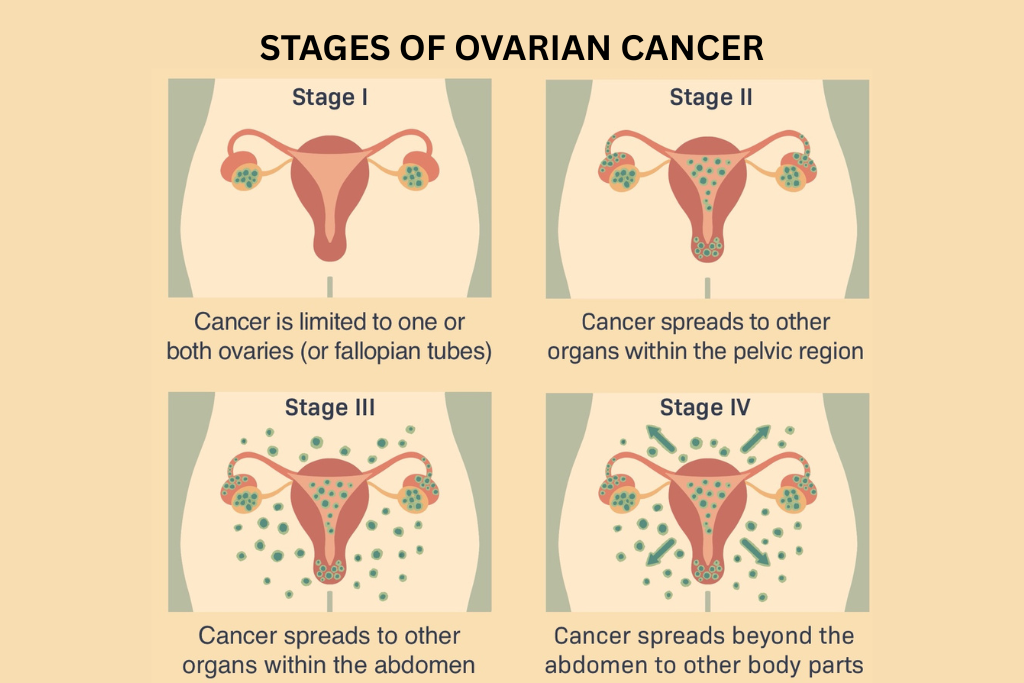
The process of staging ovarian cancer is based on the FIGO (International Federation of Gynaecology and Obstetrics) system with Stage 1 at one extreme and Stage 4 at the opposite end. Each of the phases represents the cancer diffusion stages, the localised growth in the ovaries or the distant extension in other organs.
Stage 1 Ovarian Cancer
Stage 1 ovarian cancer means the cancer is only in one or both ovaries or fallopian tubes. This stage may be further into Stage 1A (affection of one ovary), Stage 1B (affection of both ovaries), and Stage 1C (surface cancer or the rupture of a capsule of the ovary).
Stage 1 Ovarian Cancer Symptoms
Stage 1 ovarian cancer does not have many symptoms or even none and this is a factor that has made it difficult to detect the disease. The symptoms may show themselves in case of minor swelling in the stomach, slight pains in the pelvis, changes in the bowel system, or high urination. And in some cases women report with vaginal bleeding which is either abnormal or early fullness following the small meals.
Stage 1 Ovarian Cancer Treatment
Treatment usually begins with surgery to remove the affected ovaries, fallopian tubes, and often the uterus. In women who desire to maintain their fertility when the cancer is limited to one ovary, then fertility-sparing surgery can be considered. Chemotherapy is commonly advised after the surgical procedure, especially with Stage 1C cases. Newer surgery methods, such as robotic and minimally invasive methods, have good recovery and are fast.
Stage 1 Ovarian Cancer Survival Rate
The prognosis is extremely good with five years survival rates more than 90. The accuracy of the first stage (1A) is about 94% and the second stage (1C) is about 85%, which means the great importance of the detection of the disease in its first stage.
Stage 2 Ovarian Cancer
Stage 2 ovarian cancer implies that it has already extended outside ovaries to other pelvis organs like uterus, fallopian tubes, bladder or rectum despite being localized in the pelvic region.
Stage 2 Ovarian Cancer Symptoms
The symptoms become severe and prolonged. The regular lower belly or waist pain in women, constant bloating, stomach swelling, difficulty with eating or fullness, frequent urination, constipation, back pain, fatigue, and unanticipated weight loss are common.
Stage 2 Ovarian Cancer Treatment
The treatment involves complete removal of the tumour using a surgery, including ovaries and fallopian tubes, uterus and any detected cancerous tissue in the pelvis. Surgical debulking is to remove all visible cancer and this goes a long way in improving the outcome. The common post-surgical chemotherapy is the administration of taxanes-based chemotherapy using platinum. Our group in the Surgical Oncology Solutions implies the use of the most developed HIPEC (Hyperthermic Intraperitoneal Chemotherapy) in the selected Stage 2 patients that receive treatment of heated chemotherapy delivery into the abdominal cavity under surgery and is more efficient.
Stage 2 Ovarian Cancer Survival Rate
The 5-year survival rates are found to be between 70-80 percent depending on the extent of the pelvic metastases and the quality of the surgery procedure. Proper chemotherapy and debulking surgery has proved to be very effective in improving the results.
Stage 3 Ovarian Cancer
Ovarian cancer stage 3 is a late stage where the ovarian cancer has moved to other regions outside the abdomen cavity that might include the peritoneum, lymph nodes, or other surfaces of other body organs such as the liver or the spleen. At this stage, ovarian cancers are detected in about 60 percent.
Stage 3 Ovarian Cancer Symptoms
The symptoms are also much worse. Fluid build-up (ascites) in the abdominal area causes severe abdominal swelling, continuous severe abdominal pain, problems with breathing because of the diaphragm pressure, extreme fatigue, poor appetite with enormous weight loss, and recurrent digestive problems such as nausea and vomiting.
Stage 3 Ovarian Cancer Treatment
The therapy uses a strong approach involving a combination of extensive cytoreductive surgery all over the abdomen with severe programmes of chemotherapy. HIPEC has demonstrated impressive outcomes on stage 3 patients and has provided better survival rates. Surgical Oncology Solutions also uses PIPAC (Pressurised Intraperitoneal Aerosol Chemotherapy) with patients whose cancer cannot be removed completely, which is a ray of hope using new methods.
Stage 3 Ovarian Cancer Survival Rate
The five-year survival rate is between 39% and 59%, and it depends on how far the cancer has spread and how well the surgery removes it. Patients whose surgery removes all visible cancer usually do much better.
Stage 4 Ovarian Cancer
The 4th stage of ovarian cancer is the most progressive type of the disease, i.e. it has spread to other body parts other than the abdomen, such as lungs, the liver parenchyma or other lymph nodes that are many miles away.
Stage 4 Ovarian Cancer Symptoms
The symptoms are systemic and are severe in nature, including extreme fatigue and weakness, extreme unintentional weight loss, shortness of breath and persistent cough in the case of the lungs, extreme abdominal pain and distension, loss of appetite, and general body weaknesses.
Stage 4 Ovarian Cancer Treatment
Therapy aims at symptom management, cancer growth control and quality of life. Chemotherapy is the main therapy, sometimes administered prior to surgery (neoadjuvant chemotherapy) in order to downsize tumours. Specialised treatment and immunotherapy can be included. Surgical intervention to alleviate symptoms at times is advised.
Stage 4 Ovarian Cancer Survival Rate
The five-year survival rate is about 17-30%. Still, treatment developments, such as customised medicine strategies and new curative combinations, still have been gaining greater results in this advanced phase of treatment.
Expert Care Through Every Stage
At Surgical Oncology Solutions, we know that each stage is different and needs special care. Applying the latest technology on top of caring, our team of senior oncology surgeons, who have a long working experience of over 20 years, offers the best results, irrespective of the stage of the cancer.
We are based in Max Cancer Centre in New Delhi, and we provide a wide range of treatments involving robotic surgery, minimally invasive procedures, HIPEC, and PIPAC. We have a mission to bring the cancer experience to a hope and healing experience.
We also have walk-in consultations on Monday through Saturday (9 AM-5 PM) and also video consultations on weekends. Call our 24-hour WhatsApp care at +91-8218819398.
Frequently Asked Questions (FAQs)
Q1: Can ovarian cancer skip stages?
No, ovarian cancer has stages of development. It can, however, be diagnosed at an advanced stage, as in early stages it can show no significant symptoms.
Q2: How quickly does ovarian cancer progress between stages?
There is a great deal of progression. There are aggressive forms that can develop at a fast pace within months, and others that develop at a slow pace over a period. This is necessary to monitor all patients on a regular basis.
Q3: Is chemotherapy always necessary for stage 1 ovarian cancer?
Not always. Stage 1A can even be treated without the use of chemotherapy in case the tumour is completely resected and presents with positive features. But Stage 1C in general responds well to adjuvant chemotherapy to minimise the chances of recurrence.
Q4: Can stage 4 ovarian cancer ever be cured?
Stage 4 is not easily cured and some patients can be cured with aggressive treatment and remit successfully long term. It is still in the development of targeted therapies to improve the current outcomes and allow the patient to live longer.
Q5: What follow-up schedule is recommended after treatment?
Follow up is done typically by appointments every 3-4 months during the first two years, then every 6 months, physical examinations, CA-125 blood tests and imaging as needed depending on the stage.

